Levi's Aart Casual Canvas Comfort Oxford Athletic Style Fashion Shoes
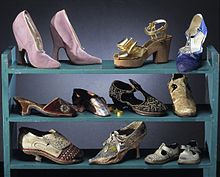
A shoe is an item of footwear intended to protect and comfort the man foot. Shoes are besides used every bit an particular of decoration and fashion. The design of shoes has varied enormously through time and from culture to culture, with form originally being tied to function. Though the human being foot can adapt to varied terrains and climate conditions, information technology is still vulnerable to ecology hazards such as abrupt rocks and temperature extremes, which shoes protect against. Some shoes are worn equally prophylactic equipment, such as steel-toe boots which are required footwear at industrial worksites.
Additionally, fashion has often dictated many design elements, such as whether shoes have very high heels or flat ones. Contemporary footwear varies widely in style, complexity and toll. Basic sandals may consist of only a thin sole and simple strap and be sold for a depression price. Loftier fashion shoes made by famous designers may be made of expensive materials, use complex structure and sell for large sums of money. Some shoes are designed for specific purposes, such as boots designed specifically for mountaineering or skiing, while others have more generalized usage such every bit sneakers which accept transformed from a special purpose sport shoe into a full general use shoe.
Traditionally, shoes have been fabricated from leather, wood or canvas, only are increasingly beingness made from rubber, plastics, and other petrochemical-derived materials.[1] Globally, the shoe industry is a $200 billion a yr manufacture.[1] xc% of shoes terminate upwardly in landfills, because the materials are hard to split, recycle or otherwise reuse.[1]
History
Artifact

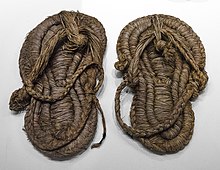

The earliest known shoes are sagebrush bawl sandals dating from approximately 7000 or 8000 BC, establish in the Fort Rock Cave in the Us land of Oregon in 1938.[5] The world's oldest leather shoe, made from a unmarried piece of cowhide laced with a leather string along seams at the front and back, was constitute in the Areni-1 cave complex in Armenia in 2008 and is believed to appointment to 3500 BC.[6] [7] Ötzi the Iceman's shoes, dating to 3300 BC, featured chocolate-brown bearskin bases, deerskin side panels, and a bawl-string cyberspace, which pulled tight around the foot.[half dozen] The Jotunheimen shoe was discovered in August 2006: archaeologists gauge that this leather shoe was made between 1800 and 1100 BC,[8] making it the oldest article of clothing discovered in Scandinavia.
Information technology is thought that shoes may have been used long before this, but because the materials used were highly perishable, information technology is difficult to discover bear witness of the earliest footwear.[9] By studying the bones of the smaller toes (every bit opposed to the large toe), it was observed that their thickness decreased approximately xl,000 to 26,000 years ago. This led archaeologists to deduce that wearing shoes resulted in less os growth, resulting in shorter, thinner toes.[ten] These primeval designs were very simple in design, often mere "human foot bags" of leather to protect the feet from rocks, debris, and cold.
Many early natives in Northward America wore a like blazon of footwear, known as the moccasin. These are tight-fitting, soft-soled shoes typically made out of leather or bison hides. Many moccasins were besides decorated with various beads and other adornments. Moccasins were not designed to be waterproof, and in wet conditions and warm summertime months, almost Native Americans went barefoot.[11]
As civilizations began to develop, thong sandals (the precursors of the modern flip-flop) were worn. This do dates back to pictures of them in ancient Egyptian murals from 4000 BC. Ane pair found in Europe was made of papyrus leaves and dated to be approximately one,500 years quondam. They were also worn in Jerusalem during the first century of the Common Era.[12] Thong sandals were worn by many civilizations and made from a broad diverseness of materials. Ancient Egyptian sandals were made from papyrus and palm leaves. The Masai of Africa made them out of rawhide. In Republic of india they were made from wood. In China and Nihon, rice straw was used. The leaves of the sisal plant were used to make twine for sandals in Southward America while the natives of Mexico used the Yucca found.[13] [fourteen]
While thong sandals were unremarkably worn, many people in ancient times, such as the Egyptians, Hindus and Greeks, saw little need for footwear, and virtually of the time, preferred being barefoot. The Egyptians and Hindus fabricated some use of ornamental footwear, such as a soleless sandal known every bit a "Cleopatra",[ citation needed ] which did not provide any practical protection for the foot. The ancient Greeks largely viewed footwear as cocky-indulgent, unaesthetic and unnecessary. Shoes were primarily worn in the theater, as a ways of increasing stature, and many preferred to go barefoot.[15] Athletes in the Aboriginal Olympic Games participated barefoot—and naked.[sixteen] Even the gods and heroes were primarily depicted barefoot, the hoplite warriors fought battles in bare anxiety and Alexander the Great conquered his vast empire with barefoot armies. The runners of Ancient Hellenic republic are besides believed to have run barefoot.[17]
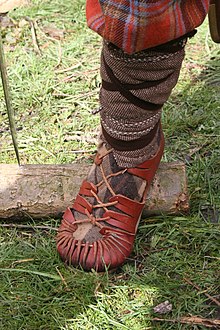
Footwear of Roman soldiers (reconstruction)
The Romans, who eventually conquered the Greeks and adopted many aspects of their culture, did not prefer the Greek perception of footwear and vesture. Roman clothing was seen as a sign of power, and footwear was seen as a necessity of living in a civilized world, although the slaves and paupers unremarkably went barefoot.[fifteen] Roman soldiers were issued with chiral (left and correct shoe different) footwear.[18] Shoes for soldiers had riveted insoles to extend the life of the leather, increase comfortability, and provide amend traction. The design of these shoes too designated the rank of the officers. The more intricate the insignia and the higher up the boot went on the leg, the higher the rank of the soldier.[nineteen] There are references to shoes existence worn in the Bible.[20]
Starting effectually 4 BC, the Greeks began wearing symbolic footwear. These were heavily decorated to conspicuously bespeak the condition of the wearer. Courtesans wore leather shoes colored with white, green, lemon or yellow dyes, and young adult female matrimonial or newly married wore pure white shoes. Because of the price to lighten leather, shoes of a paler shade were a symbol of wealth in the upper class. Often, the soles would be carved with a message so it would imprint on the ground. Cobblers became a notable profession around this time, with Greek shoemakers becoming famed in the Roman empire.[21]
Heart Ages and Early on Modernistic period
A common coincidental shoe in the Pyrenees during the Center Ages was the espadrille. This is a sandal with braided jute soles and a fabric upper portion, and ofttimes includes fabric laces that tie around the ankle. The term is French and comes from the esparto grass. The shoe originated in the Catalonian region of Kingdom of spain as early as the 13th century, and was commonly worn by peasants in the farming communities in the area.[xiv]
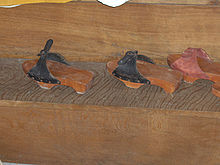
In medieval times shoes could be upwards to 2 feet long, with their toes sometimes filled with hair, wool, moss, or grass.[22] Many medieval shoes were made using the turnshoe method of structure, in which the upper was turned flesh side out, and was lasted onto the sole and joined to the edge by a seam.[23] The shoe was then turned inside-out so that the grain was exterior. Some shoes were developed with toggled flaps or drawstrings to tighten the leather around the foot for a better fit. Surviving medieval turnshoes often fit the human foot closely, with the right and left shoe existence mirror images.[24] Effectually 1500, the turnshoe method was largely replaced past the welted rand method (where the uppers are sewn to a much stiffer sole and the shoe cannot be turned inside-out).[25] The turn shoe method is still used for some dance and specialty shoes.
Past the 15th century, pattens became popular by both men and women in Europe. These are unremarkably seen every bit the predecessor of the mod loftier-heeled shoe,[26] while the poor and lower classes in Europe, too as slaves in the New World, were barefoot.[15] In the 15th century, the Crakow was fashionable in Europe. This manner of shoe is named because information technology is thought to accept originated in Kraków, the capital of Poland. The style is characterized by the point of the shoe, known as the "polaine", which often was supported by a whalebone tied to the knee to forestall the betoken getting in the way while walking.[27] Also during the 15th century, chopines were created in Turkey, and were ordinarily 7–viii inches (17.7–twenty.iii cm) loftier. These shoes became popular in Venice and throughout Europe, as a status symbol revealing wealth and social standing. During the 16th century, royalty, such equally Catherine de Medici or Mary I of England, started wearing high-heeled shoes to make them look taller or larger than life. By 1580, even men wore them, and a person with authority or wealth was often referred to as, "well-heeled".[26] In 17th century French republic, heels were exclusively worn by aristocrats. Louis XIV of France outlawed everyone from wearing red high heels except for himself and his majestic court.[28]
Eventually the modern shoe, with a sewn-on sole, was devised. Since the 17th century, most leather shoes have used a sewn-on sole. This remains the standard for finer-quality clothes shoes today. Until around 1800, welted rand shoes were usually made without differentiation for the left or right foot. Such shoes are now referred to as "straights".[29] Only gradually did the mod human foot-specific shoe become standard.
Industrial era

A shoemaker in the Georgian era, from The Book of English Trades, 1821.
Shoemaking became more commercialized in the mid-18th century, as information technology expanded as a cottage industry. Large warehouses began to stock footwear, fabricated by many small manufacturers from the area.
Until the 19th century, shoemaking was a traditional handicraft, but by the century's finish, the process had been nigh completely mechanized, with production occurring in large factories. Despite the obvious economical gains of mass production, the factory system produced shoes without the individual differentiation that the traditional shoemaker was able to provide.
The outset steps towards mechanisation were taken during the Napoleonic Wars by the engineer, Marc Brunel. He adult mechanism for the mass production of boots for the soldiers of the British Army. In 1812, he devised a scheme for making nailed-kicking-making mechanism that automatically fastened soles to uppers past ways of metal pins or nails.[xxx] With the support of the Duke of York, the shoes were manufactured, and, due to their strength, cheapness, and durability, were introduced for the use of the army. In the aforementioned yr, the use of screws and staples was patented past Richard Woodman. Brunel'south arrangement was described by Sir Richard Phillips equally a visitor to his factory in Battersea equally follows:
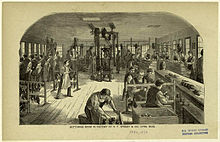
Past the late 19th century, the shoemaking industry had migrated to the factory and was increasingly mechanized. Pictured, the bottoming room of the B. F. Spinney & Co. factory in Lynn, Massachusetts, 1872.
In another building I was shown his factory of shoes, which, like the other, is total of ingenuity, and, in regard to subdivision of labour, brings this cloth on a level with the oft-admired manufactory of pins. Every step in it is afflicted by the nearly elegant and precise mechanism; while, as each functioning is performed by one hand, and so each shoe passes through xx-five hands, who complete from the hibernate, as supplied by the currier, a hundred pairs of strong and well-finished shoes per day. All the details are performed by the ingenious application of the mechanic powers; and all the parts are characterised by precision, uniformity, and accuracy. As each man performs but ane step in the process, which implies no knowledge of what is washed past those who go before or follow him, so the persons employed are not shoemakers, but wounded soldiers, who are able to learn their respective duties in a few hours. The contract at which these shoes are delivered to Regime is 6s. 6d. per pair, existence at to the lowest degree 2s. less than what was paid previously for an unequal and cobbled commodity.[31]
Nevertheless, when the state of war ended in 1815, transmission labour became much cheaper, and the demand for war machine equipment subsided. As a result, Brunel's system was no longer profitable and information technology soon ceased business.[30]
Like exigencies at the time of the Crimean War stimulated a renewed interest in methods of mechanization and mass-product, which proved longer lasting.[thirty] A shoemaker in Leicester, Tomas Crick, patented the design for a riveting motorcar in 1853. His machine used an iron plate to push iron rivets into the sole. The process greatly increased the speed and efficiency of production. He also introduced the use of steam-powered rolling-machines for hardening leather and cutting-machines, in the mid-1850s.[32]

Advertizement in an 1896 effect of McClure's for "The Regal".

The sewing machine was introduced in 1846, and provided an alternative method for the mechanization of shoemaking. By the belatedly 1850s, the industry was beginning to shift towards the modernistic mill, mainly in the U.s.a. and areas of England. A shoe-stitching machine was invented by the American Lyman Blake in 1856 and perfected by 1864. Entering into a partnership with McKay, his device became known as the McKay stitching machine and was apace adopted by manufacturers throughout New England.[33] As bottlenecks opened up in the production line due to these innovations, more than and more of the manufacturing stages, such as pegging and finishing, became automated. By the 1890s, the process of mechanisation was largely consummate.
On January 24, 1899, Humphrey O'Sullivan of Lowell, Massachusetts, was awarded a patent for a rubber heel for boots and shoes.[34]
A procedure for manufacturing stitchless, that is, glued, shoes—Ago—was developed in 1910. Since the mid-20th century, advances in rubber, plastics, synthetic fabric, and industrial adhesives accept allowed manufacturers to create shoes that stray considerably from traditional crafting techniques. Leather, which had been the primary material in earlier styles, has remained standard in expensive dress shoes, but athletic shoes often have little or no existent leather. Soles, which were in one case laboriously paw-stitched on, are at present more than often car stitched or simply glued on. Many of these newer materials, such as rubber and plastics, have made shoes less biodegradable. It is estimated that most mass-produced shoes require yard years to degrade in a landfill.[35] In the late 2000s, some shoemakers picked upward on the outcome and began to produce shoes made entirely from degradable materials, such as the Nike Considered.[36] [37]
In 2007, the global shoe manufacture had an overall market of $107.iv billion, in terms of revenue, and is expected to grow to $122.9 billion by the cease of 2012. Shoe manufacturers in the People's Republic of Prc account for 63% of production, 40.5% of global exports and 55% of manufacture revenue. Even so, many manufacturers in Europe dominate the higher-priced, higher value-added finish of the market.[38]
Culture and folklore


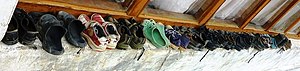
Children'southward shoes at school in Ladakh
As an integral part of man culture and civilization, shoes take establish their manner into our culture, folklore, and fine art. A popular 18th-century nursery rhyme is There was an Old Woman Who Lived in a Shoe. This story tells about an old adult female living in a shoe with a lot of children. In 1948, Mahlon Haines, a shoe salesman in Hallam, Pennsylvania, built an actual business firm shaped like a piece of work boot as a form of advertisement. The Haines Shoe Business firm was rented to newlyweds and the elderly until his death in 1962. Since then, information technology has served as an ice foam parlor, a bed and breakfast, and a museum. It still stands today and is a popular roadside attraction.[39]
Shoes as well play an important function in the fairy tales Cinderella and The Red Shoes. In the movie adaption of the children's book The Wonderful Wizard of Oz, a pair of red ruby-red slippers play a primal role in the plot. The 1985 comedy The Man with I Cherry Shoe features an eccentric homo wearing one normal business shoe and ane red shoe that becomes cardinal to the plot.
Athletic sneaker collection has too existed as a part of urban subculture in the The states for several decades.[40] Recent decades have seen this tendency spread to European nations such every bit the Czechia.[41] A Sneakerhead is a person who owns multiple pairs of shoes as a class of collection and mode. A contributor to the growth of sneaker collecting is the continued worldwide popularity of the Air Hashemite kingdom of jordan line of sneakers designed by Nike for Basketball star Michael Jordan.
In the Bible'southward Erstwhile Testament, the shoe is used to symbolize something that is worthless or of little value. In the New Testament, the deed of removing one's shoes symbolizes servitude. Ancient Semitic-speaking peoples regarded the human activity of removing their shoes as a mark of reverence when approaching a sacred person or place.[42] In the Book of Exodus, Moses was instructed to remove his shoes earlier approaching the burning bush-league:
Put off thy shoes from off thy anxiety, for the place whereon grand standest [is] holy ground (Exodus 3:5).

The removal of the shoe too symbolizes the act of giving upwardly a legal correct. In Hebrew custom, the widow removed the shoe of her tardily married man'south blood brother to symbolize that he had abased his duty. In Arab custom, the removal of one's shoe also symbolized the dissolution of matrimony.[42]
In Arab culture, showing the sole of one'due south shoe is considered an insult, and to throw a shoe and hit someone with it is considered an fifty-fifty greater insult. Shoes are considered to be dirty as they oftentimes impact the ground, and are associated with the lowest office of the body—the foot. As such, shoes are forbidden in mosques, and it is likewise considered unmannerly to cantankerous the legs and brandish the soles of ane'due south shoes during conversation. This insult was demonstrated in Iraq, outset when Saddam Hussein's statue was toppled in 2003, Iraqis gathered around it and struck the statue with their shoes.[43] In 2008, U.s.a. President George W. Bush had a shoe thrown at him by a journalist as a argument against the war in Iraq.[44] More generally, shoe-throwing or shoeing, showing the sole of 1's shoe or using shoes to insult are forms of protest in many parts of the earth. Incidents where shoes were thrown at political figures accept taken place in Australia, India, Ireland, Taiwan, Hong Kong, Pakistan, the Great britain, the Usa, and about notably the Arab world.[45] [46]
Empty shoes may as well symbolize death. In Greek culture, empty shoes are the equivalent of the American funeral wreath. For example, empty shoes placed outside of a Greek dwelling would tell others that the family'due south son has died in boxing.[47] At an observation memorializing the 10th anniversary of the September 11 attacks, iii,000 pairs of empty shoes were used to recognize those killed.[48] The Shoes on the Danube Bank is a memorial in Budapest, Hungary. Conceived past motion-picture show director Can Togay, he created it on the e bank of the Danube River with sculptor Gyula Pauer to honor the Jews who were killed past fascist Pointer Cross militiamen in Budapest during World State of war II. They were ordered to take off their shoes and were shot at the edge of the water then that their bodies fell into the river and were carried abroad. The memorial represents their shoes left behind on the banking concern.
Construction
The basic anatomy of a shoe is recognizable, regardless of the specific style of footwear.
All shoes take a sole , which is the lesser of a shoe, in contact with the ground. Soles tin can be made from a variety of materials, although most modern shoes have soles made from natural rubber, polyurethane, or polyvinyl chloride (PVC) compounds.[49] Soles tin can be simple—a single material in a single layer—or they can be complex, with multiple structures or layers and materials. When various layers are used, soles may consist of an insole, midsole, and an outsole.[50]
The insole is the interior bottom of a shoe, which sits directly below the human foot under the footbed (also known every bit sock liner). The purpose of the insole is to attach to the lasting margin of the upper, which is wrapped around the final during the closing of the shoe during the lasting operation. Insoles are ordinarily fabricated of cellulosic paper lath or synthetic non woven insole board. Many shoes have removable and replaceable footbeds. Extra cushioning is often added for comfort (to control the shape, moisture, or smell of the shoe) or health reasons (to help deal with differences in the natural shape of the foot or positioning of the foot during continuing or walking).[50]
The outsole is the layer in direct contact with the basis. Apparel shoes often have leather or resin safety outsoles; coincidental or piece of work-oriented shoes accept outsoles made of natural rubber or a synthetic cloth like polyurethane. The outsole may comprise a single piece or maybe an assembly of separate pieces, often of different materials. On some shoes, the heel of the sole has a rubber plate for durability and traction, while the forepart is leather for style. Specialized shoes will oft have modifications on this design: athletic or so-called cleated shoes like soccer, rugby, baseball and golf game shoes have spikes embedded in the outsole to improve traction.[50]
The midsole is the layer in between the outsole and the insole, typically at that place for shock absorption. Some types of shoes, like running shoes, accept additional fabric for stupor absorption, ordinarily beneath the heel of the human foot, where one puts the nigh pressure downwards. Some shoes may non have a midsole at all.[50]
The heel is the lesser rear part of a shoe. Its function is to support the heel of the human foot. They are oft made of the same fabric equally the sole of the shoe. This part tin can be high for fashion or to make the person look taller, or flat for more practical and comfortable use.[50] On some shoes the inner forward point of the heel is chiselled off, a feature known equally a "gentleman's corner". This slice of design is intended to alleviate the problem of the points catching the bottom of trousers and was first observed in the 1930s.[51] A heel is the projection at the back of a shoe which rests below the heel os. The shoe heel is used to improve the balance of the shoe, increase the summit of the wearer, alter posture or other decorative purposes. Sometimes raised, the high heel is common to a course of shoe oftentimes worn by women, but sometimes past men also. See also stiletto heel.
The upper helps hold the shoe onto the foot. In the simplest cases, such as sandals or flip-flops, this may exist nothing more than than a few straps for holding the sole in place. Closed footwear, such every bit boots, trainers and most men'due south shoes, will take a more complex upper. This part is often decorated or is fabricated in a certain manner to expect attractive. The upper is connected to the sole by a strip of leather, rubber, or plastic that is stitched between information technology and the sole, known as a welt.[50]
Most uppers take a machinery, such as laces, straps with buckles, zippers, rubberband, velcro straps, buttons, or snaps, for tightening the upper on the human foot. Uppers with laces normally have a tongue that helps seal the laced opening and protect the foot from abrasion by the laces. Uppers with laces as well have eyelets or hooks to make it easier to tighten and loosen the laces and to forbid the lace from vehement through the upper material. An aglet is the protective wrapping on the end of the lace.
The vamp is the front function of the shoe, starting behind the toe, extending around the eyelets and tongue and towards back office of the shoe.
The medial is the part of the shoe closest to a person's center of symmetry, and the lateral is on the opposite side, abroad from their center of symmetry. This tin exist in reference to either the outsole or the vamp. Most shoes have shoelaces on the upper, connecting the medial and lateral parts after one puts their shoes on and aiding in keeping their shoes on their anxiety. In 1968, Puma SE introduced the first pair of sneakers with Velcro straps in lieu of shoelaces, and these became popular by the 1980s, particularly among children and the elderly.[52] [53]
The toe box is the part that covers and protects the toes. People with toe deformities, or individuals who feel toe swelling (such every bit long-distance runners) usually require a larger toe box.[54]
-

Diagram of a typical dress shoe. Note that the surface area labeled every bit the "Lace guard" is sometimes considered role of the quarter and sometimes office of the vamp.
-
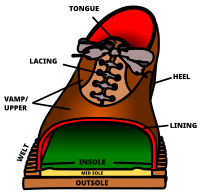
Cutaway view of a typical shoe.
Types
There are a wide variety of different types of shoes. Most types of shoes are designed for specific activities. For example, boots are typically designed for work or heavy outdoor use. Able-bodied shoes are designed for particular sports such as running, walking, or other sports. Some shoes are designed to be worn at more formal occasions, and others are designed for casual wear. At that place are also a wide multifariousness of shoes designed for different types of dancing. Orthopedic shoes are special types of footwear designed for individuals with item foot problems or special needs. Other animals, such as dogs and horses, may also wear special shoes to protect their feet besides.
Depending on the activity for which they are designed, some types of footwear may fit into multiple categories. For example, Cowboy boots are considered boots, only may also exist worn in more formal occasions and used equally dress shoes. Hiking boots incorporate many of the protective features of boots, but also provide the extra flexibility and comfort of many athletic shoes. Flip-flops are considered coincidental footwear, only take also been worn in formal occasions, such as visits to the White House.[55] [56]
Athletic
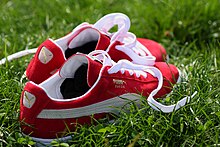
A pair of athletic running shoes
Athletic shoes are specifically designed to be worn for participating in various sports. Since friction between the foot and the ground is an important forcefulness in most sports, mod athletic shoes are designed to maximize this force, and materials, such as rubber, are used. Although, for some activities such as dancing or bowling, sliding is desirable, so shoes designed for these activities often have lower coefficients of friction.[57] The earliest athletic shoes date back to the mid 19th century were rails spikes—leather shoes with metal cleats on the soles to provide increased friction during running. They were developed by J.Westward. Foster & Sons, which later become known every bit Reebok. Past the end of the 19th century, Spalding as well manufactured these shoes too. Adidas started selling shoes with rails spikes in them for running and soccer in 1925. Spikes were eventually added to shoes for baseball and American football in the 20th century.[14] Golfers likewise utilise shoes with small metal spikes on their soles to prevent slipping during their swing.[58]
The earliest rubber-soled athletic shoes appointment dorsum to 1876 in the United kingdom, when the New Liverpool Rubber Company made plimsolls, or sandshoes, designed for the sport of croquet. Similar rubber-soled shoes were made in 1892 in the United states past Humphrey O'Sullivan, based on Charles Goodyear'southward engineering. The United States Rubber Company was founded the aforementioned year and produced safe-soled and heeled shoes under a multifariousness of brand names, which were later consolidated in 1916 under the name, Keds. These shoes became known as, "sneakers", considering the rubber sole immune the wearer to sneak upwards on another person. In 1964, the founding of Nike by Phil Knight and Bill Bowerman of the University of Oregon introduced many new improvements common in modern running shoes, such every bit prophylactic waffle soles, breathable nylon uppers, and cushioning in the mid-sole and heel. During the 1970s, the expertise of podiatrists also became of import in able-bodied shoe design, to implement new blueprint features based on how feet reacted to specific deportment, such as running, jumping, or side-to-side movement. Athletic shoes for women were also designed for their specific physiological differences.[xiv]
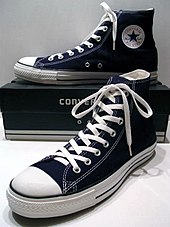
A pair of Converse All-Stars
Shoes specific to the sport of basketball game were developed by Chuck Taylor, and are popularly known as Chuck Taylor All-Stars. These shoes, first sold in 1917, are double-layer canvas shoes with rubber soles and toe caps, and a high heel (known equally a "high top") for added back up. In 1969, Taylor was inducted into the Naismith Memorial Basketball Hall of Fame in recognition of this development, and in the 1970s, other shoe manufacturers, such every bit Nike, Adidas, Reebok, and others began imitating this style of athletic shoe.[59] In April 1985, Nike introduced its ain brand of basketball shoe which would become popular in its own right, the Air Jordan, named after the and so-rookie Chicago Bulls basketball histrion, Michael Jordan. The Air Hashemite kingdom of jordan line of shoes sold $100 million in their starting time year.[threescore]
As barefoot running became pop by the late 20th and early on 21st century, many modern shoe manufacturers have recently designed footwear that mimic this feel, maintaining optimum flexibility and natural walking while too providing some degree of protection. Termed as Minimalist shoes, their purpose is to allow 1's feet and legs to experience more subtly the impacts and forces involved in running, allowing finer adjustments in running way.[61] Some of these shoes include the Vibram FiveFingers,[62] Nike Costless,[63] and Saucony's Kinvara and Hattori.[64] [65] Mexican huaraches are too very simple running shoes, similar to the shoes worn by the Tarahumara people of northern Mexico, who are known for their altitude running abilities.[66] Wrestling shoes are likewise very light and flexible shoes that are designed to mimic bare feet while providing additional traction and protection.
Many athletic shoes are designed with specific features for specific activities. 1 of these includes roller skates, which take metal or plastic wheels on the bottom specific for the sport of roller skating. Similarly, ice skates have a metal blade attached to the bottom for locomotion across water ice. Skate shoes take also been designed to provide a comfortable, flexible and durable shoe for the sport of skateboarding.[67] Climbing shoes are rubber-soled, tight-fitting shoes designed to fit in the small cracks and crevices for rock climbing. Cycling shoes are similarly designed with rubber soles and a tight fit, simply also are equipped with a metal or plastic cleat to interface with clipless pedals, besides equally a stiff sole to maximize power transfer and back up the foot.[68] Some shoes are made specifically to improve a person's ability to weight railroad train.[69] Sneakers that are a mix between an action-centered and a more standard pattern have also been produced: examples include roller shoes, which feature wheels that can be used to roll on difficult ground, and Soap shoes, which feature a hard plastic sole that tin be used for grinding.
Boot
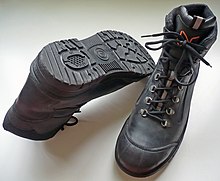
A kicking is a special type of shoe which covers the foot and the ankle and extends up the leg, sometimes every bit far as the knee or even the hip. Most boots take a heel that is clearly distinguishable from the remainder of the sole, fifty-fifty if the two are made of one slice. They are typically made of leather or condom, although they may be fabricated from a variety of different materials. Boots are worn both for their functionality—protecting the human foot and leg from water, snow, mud or hazards or providing boosted talocrural joint support for strenuous activities—as well as for reasons of style and style.
Cowboy boots are a specific way of riding kick which combines part with fashion. They became popular among cowboys in the western United States during the 19th century. Traditional cowboy boots have a Cuban heel, rounded to pointed toe, loftier shaft, and, traditionally, no lacing.[70] They are normally fabricated from cowhide leather simply may be made from more than exotic skins such as ostrich, anaconda, or elephant skins.[71]
Hiking boots are designed to provide extra talocrural joint and curvation back up, also as actress padding for condolement during hiking. They are constructed to provide comfort for miles of walking over crude terrains, and protect the hiker'south anxiety against water, mud, rocks, and other wilderness obstacles. These boots support the ankle to avert twisting but do not restrict the ankle'southward movement too much. They are fairly strong to support the foot. A properly fitted boot and/or friction-reducing patches applied to troublesome areas ensures protection against blisters and other discomforts associated with long hikes on rugged terrain.[72]
During moisture or snowy conditions, snow boots are worn to keep the human foot warm and dry. They are typically made of safe or other water-resistant fabric, take multiple layers of insulation, and a loftier heel to continue snow out.[73] Boots may also exist attached to snowshoes to increase the distribution of weight over a larger surface surface area for walking in snow. Ski boots are a specialized snow boot which are used in alpine or cross-country skiing and designed to provide a fashion to adhere the skier to his/her skis using ski bindings. The ski/kicking/binding combination is used to effectively transmit command inputs from the skier'southward legs to the snow. Ice skates are another specialized kick with a metal blade attached to the bottom which is used to propel the wearer across a sheet of water ice.[74] Inline skates are like to ice skates only with a set of three to iv wheels in lieu of the blade, which are designed to mimic ice skating on solid surfaces such as wood or concrete.[75]
Boots are designed to withstand heavy vesture to protect the wearer and provide good traction. They are mostly fabricated from sturdy leather uppers and non-leather outsoles. They may be used for uniforms of the police or war machine, as well as for protection in industrial settings such as mining and construction. Protective features may include steel-tipped toes and soles or ankle guards.[76]
Dress and casual
Clothes shoes are characterized past shine and supple leather uppers, leather soles, and narrow sleek figure. Casual shoes are characterized by sturdy leather uppers, not-leather outsoles, and wide profile.
Some designs of dress shoes can exist worn by either gender. The majority of dress shoes accept an upper roofing, ordinarily made of leather, enclosing virtually of the lower foot, simply not covering the ankles. This upper part of the shoe is oft made without apertures or openings, only may as well be made with openings or fifty-fifty itself consist of a series of straps, e.m. an open toe featured in women'southward shoes. Shoes with uppers made high to cover the ankles are also available; a shoe with the upper rise above the ankle is usually considered a kick but certain styles may be referred to as high-topped shoes or high-tops. Usually, a loftier-topped shoe is secured past laces or zippers, although some styles accept elastic inserts to ease slipping the shoe on.
Men'due south

This male person clothes shoe, known as a derby shoe, is distinguished by its open up lacing.
Men'south shoes can be categorized past how they are closed:
- Oxfords (also referred as "Balmorals"): the vamp has a 5-shaped slit to which the laces are fastened; also known as "closed lacing". The give-and-take "Oxford" is sometimes used by American clothing companies to market shoes that are not Balmorals, such as bluchers.
- Derby shoe: the laces are tied to ii pieces of leather independently fastened to the vamp; also known equally "open up lacing" and is a stride down in dressiness. If the laces are non independently fastened to the vamp, the shoe is known as a blucher shoe. This name is, in American English, often used about derbys.
- Monk-straps: a buckle and strap instead of lacing
- Slip-ons: There are no lacings or fastenings. The popular loafers are role of this category, too as less popular styles, such every bit elastic-sided shoes.
Men'south shoes tin can too be decorated in diverse means:
- Evidently-toes: accept a sleek appearance and no actress decorations on the vamp.
- Cap-toes: has an actress layer of leather that "caps" the toe.
- Brogues (American: wing-tips): The toe of the shoe is covered with a perforated panel, the fly-tip, which extends down either side of the shoe. Brogues can be found in both balmoral and blucher styles, just are considered slightly less formal.
Formal high-end men's shoes are manufactured by several companies around the world, amongst others in Great Britain, French republic, Hungary, Romania, Croatia, Italy, and to a lesser extent in the U.s.. Notable British brands include: Church'southward English language Shoes (est. 1873), John Lobb Bootmaker (est. 1849), Edward Green Shoes (est. 1890), and Crockett & Jones (est. 1879). Both John Lobb and Edward Greenish offering bespoke products. In betwixt the world wars, men's footwear received pregnant innovation and design, led by cobblers and cordwainers in London's West End.[77] A well-known French maker is J.One thousand. Weston. Armani of Italy was a major influence on men's shoe design in the 1960s–1980s until they returned to the larger proportions of its forebears, the welt-constructed Anglo-American dress shoe originally created in Edwardian England. Another well-known Italian company is Salvatore Ferragamo Italian republic S.p.A. Higher cease companies in the United States are Allen Edmonds and Alden Shoe Company. Alden, located in New England, specializes in genuine shell cordovan leather from the just remaining horse tannery in the U.s.a., in Chicago[78] and is completely manufactured domestically, whereas Allen Edmonds, of Wisconsin, is a larger company that outsources some of its production.[79]
Women's

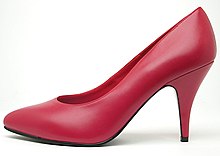
There is a large variety of shoes bachelor for women, in add-on to most of the men's styles existence more accepted as unisex. Some broad categories are:
- Loftier-heeled footwear is footwear that raises the heels, typically 2 inches (five cm) or more above the toes, commonly worn by women for formal occasions or social outings. Variants include kitten heels (typically 1+ i⁄2 –2 inches loftier) and stiletto heels (with a very narrow heel post) and wedge heels (with a wedge-shaped sole rather than a heel mail).
- Mules are shoes or slippers with no fitting around the heel (i.due east. they are backless)
- Slingbacks are shoes which are secured by a strap behind the heel, rather than over the top of the foot.
- Ballet flats, known in the Great britain as ballerinas, ballet pumps or skimmers, are shoes with a very depression heel and a relatively short vamp, exposing much of the instep. They are popular for warm-weather wear, and may be seen equally more comfortable than shoes with a college heel.
- Courtroom shoes, known in the U.s. equally pumps, are typically loftier-heeled, slip-on wearing apparel shoes.
Unisex
- Clog
- Platform shoe: shoe with very thick soles and heels
- Sandals: open shoes consisting of a sole and various straps, leaving much of the pes exposed to air. They are thus popular for warm-weather wear, because they let the human foot be libation than a airtight-toed shoe would.
- Saddle shoe: leather shoe with a contrasting saddle-shaped ring over the instep, typically white uppers with black "saddle".
- Skid-on shoe: a clothes or coincidental shoe without shoelaces or fasteners; frequently with tassels, buckles, or coin-holders (penny loafers).
- Boat shoes, besides known as "deck shoes": similar to a loafer, but more casual. Laces are usually simple leather with no frills. Typically made of leather and featuring a soft white sole to avoid marring or scratching a boat deck. The showtime boat shoe was invented in 1935 by Paul A. Sperry.
- Slippers: For indoor employ, commonly worn with pajamas.
Dance
A wide variety of footwear is used past dancers. The option of dance shoe blazon depends on the fashion of trip the light fantastic toe that is to be performed and, in many cases, the characteristics of the surface that will exist danced on.
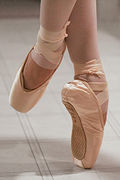
- Pointe shoes are designed for ballet dancing. These have a toe box that is stiffened with glue and a hardened sole so the dancer can stand on the tips of their toes. They are secured by elastic straps and ribbons that are tied to the dancer'southward ankles.
- Ballet shoes are soft, pliable shoes made of canvas or leather, with either continuous or two-part sole (also chosen split-sole), used for ballet dancing. The sole is typically made of leather, with thicker material under the ball and heel of the foot, and thinner and thus more flexible cloth under the arch then that the human foot can be easily pointed. They are typically secured by elastics beyond the top of the foot.
- Ghillies are soft shoes that are used in Irish gaelic dance, Scottish country trip the light fantastic, and highland dance.
- Jazz shoes typically have a two-part rubberized sole (also called split up-sole) to provide both flexibility and traction, and a short heel. They are secured to the foot by laces or elastic inserts.
- Tango and Flamenco shoes are used for tango or flamenco dancing.
- Ballroom shoes fall into two categories: Ballroom and Latin American. Both are characterised past suede soles. Men'south ballroom shoes are typically lace-ups with one-inch heels and patent leather uppers. Ladies' ballroom shoes are typically courtroom shoes with two-inch heels, made of material that tin can be colored to friction match the dancer's dress. In contrast to the low Ballroom heel, which evenly distributes weight across the foot, Latin American shoes have higher heels designed to shift weight onto the toes. Latin shoes are also more flexible than ballroom shoes. Men's Latin shoes typically take 1.5- to 2-inch high, shaped heels, while Ladies' Latin shoes have 2.5-inch to three-inch heels. Ladies shoes are typically open-toed and strapped.
- Dance sneakers are lightweight sneakers with reinforced rubber toes that allows dancers to briefly stand up on their toes. These are known past diverse trademarked names, such every bit dansneakers.
- Foot thongs are slip-on, partial foot covers that comprehend the ball of the dancer's pes then every bit to reduce friction while executing turns, thus making it easier to perform turns and too protecting the human foot from peel abrasions. From a altitude, flesh colored foot thongs give a dancer the appearance of having bare feet. They are known by various names depending on the manufacturer, including dance paws, foot undies, and foot paws.
- Tap shoes have metal plates mounted to the bottoms of the toe and heel. The metal plates, which are known as taps, make a loud sound when struck against a difficult operation surface. Tap shoes, which are used in tap dancing, may be fabricated from any style of shoe to which taps can be attached.
- Character shoes are leather shoes with one- to 3-inch heels, unremarkably with one or more than straps across the instep to secure information technology to the human foot. They may be soft-soled (suede) or hard-soled. They may be converted to tap shoes by attaching taps.
-
-

-
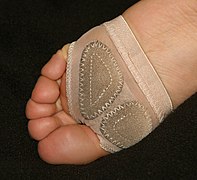
A foot thong, viewed from the bottom
-

-

Ladies' ballroom shoes
-
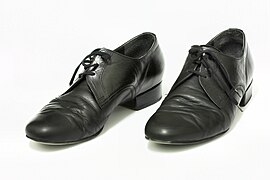
Men'due south ballroom shoes
-
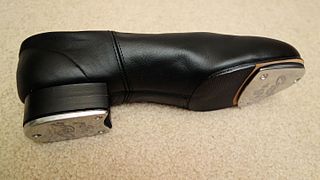
Orthopedic
Orthopedic shoes are specially-designed footwear to relieve discomfort associated with many foot and talocrural joint disorders, such every bit blisters, bunions, calluses and corns, hammer toes, plantar fasciitis, or heel spurs. Certain types of therapeutic footwear are prescribed for children[80] [81] with mobility issues.[82] They may also be worn by individuals with diabetes or people with diff leg length. These shoes typically have a low heel, tend to exist wide with a particularly wide toe box, and have a firm heel to provide extra support. Some may as well have a removable insole, or orthotic, to provide actress arch support.[14]
Measures and sizes
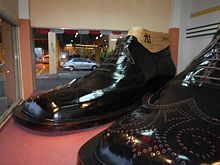
Globe's largest pair of shoes, Riverbank Heart, Philippines—5.29 metres (17.4 ft) long and ii.37 metres (vii ft nine in) broad, equivalent to a French shoe size of 75.
The measure of a pes for a shoe is from the heel to the longest toe. Shoe size is an alphanumerical indication of the plumbing fixtures size of a shoe for a person. Often it simply consists of a number indicating the length considering many shoemakers only provide a standard width for economic reasons. At that place are several dissimilar shoe-size systems that are used worldwide. These systems differ in what they measure out, what unit of measurement of measurement they use, and where the size 0 (or 1) is positioned. Only a few systems also take the width of the feet into account. Some regions use different shoe-size systems for different types of shoes (e.g., men'due south, women'due south, children'due south, sport, or rubber shoes).

Units for shoe sizes vary widely effectually the world. European sizes are measured in Paris Points, which are worth two-thirds of a centimeter. The United kingdom and American units result in whole-number sizes spaced at one barleycorn ( 1⁄3 inch), with UK adult sizes starting at size 1 = eight+ two⁄3 in (22.0 cm). In the U.s., this is size two. Men's and women'southward shoe sizes often accept different scales.[ citation needed ] Shoe size is often measured using a Brannock Device, which can determine both the width and length size values of the foot.[83] A metric standard for shoe sizing, the Mondopoint organisation, was introduced in the 1970s past International Standard ISO 2816:1973 "Fundamental characteristics of a system of shoe sizing to be known as Mondopoint" and ISO 3355:1975 "Shoe sizes – System of length grading (for utilize in the Mondopoint system)".[84] the current version of the standard is ISO 9407:2019, "Shoe sizes—Mondopoint arrangement of sizing and marking".[85] The Mondopoint organisation includes measurements of both length and width of the foot.
Accessories
- Cream tap: a small cream pad placed under the brawl of the pes to push the foot upwards and back if the shoe is as well loose.
- Heel grip: used to forestall the shoe from slipping on the heel if the fit is not perfect
- Overshoes or galoshes: a rubber covering placed over shoes for pelting and snow protection.
- Shoe bag: a pocketbook that protects shoes against damage when they are non existence worn.
- Shoe brush and polishing fabric: used to apply polish to shoes.
- Shoe insert, insole or inner sole: orthopedic or regular insert of various materials for cushioning, improved fit, reduced chafe or to keep shoe fresh and increase its immovability. These include padding and inner linings. Inserts may also exist used to correct pes problems.
- Shoe polish: a waxy material spread on shoes to improve advent and glossiness, and provide protection.
- Shoe stretcher: a tool for making a shoe longer or wider or for reducing discomfort in areas of a shoe.
- Shoe tree: placed inside the shoe when user is non wearing information technology, to help maintain the shoe's shape.
- Shoehorn: can be used to insert a foot into a shoe by keeping the shoe open and providing a shine surface for the pes to slide upon.
- Shoelaces: a organisation used to secure shoes.
- Snow shoe: a wooden or leather piece that increases the area of ground covered past the shoe.
Removal of shoes
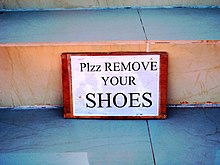
PLZZ REMOVE YOUR SHOES. Sign at entrance to stupa. Nubra, Bharat
In many places in the earth shoes are removed when moving from exteriors to interiors, particularly in homes and religious buildings. In many Asian countries outdoor shoes are exchanged for indoor shoes or slippers. Some fitness centres require that shoes exist exchanged for indoor shoes to prevent dirt and grime from existence transferred to the equipment.
See besides
- Foot binding
- Listing of shoe companies
- List of shoe styles
- Locomotor effects of shoes
- Runner's toe, injury from malfitting shoes
- Shoe dryer
- Shoe rack
- Shoe tossing
- Trousers
References
- ^ a b c Hoskins, Tansy E. (2020-03-21). "'Some soles terminal i,000 years in landfill': the truth about the sneaker mountain". The Guardian . Retrieved 2021-02-xix .
- ^ "The Scottish X". The Engine Shed. Eye for Digital Documentation and Visualisation LLP. Retrieved 14 October 2017.
- ^ "Lady's Shoe, Bar Hill". 2015-09-25. Retrieved 24 May 2018.
- ^ "Child's Shoe, Bar Hill". 2015-09-22. Retrieved 24 May 2018.
- ^ Connolly, Tom. "The World's Oldest Shoes". Academy of Oregon. Archived from the original on July 22, 2012. Retrieved July 22, 2012.
- ^ a b Ravilious, Kate (June 9, 2010). "Globe's Oldest Leather Shoe Found—Stunningly Preserved". National Geographic. Archived from the original on July 24, 2012. Retrieved July 22, 2012.
- ^ Petraglia, Michael D.; Pinhasi R; Gasparian B; Areshian Yard; Zardaryan D; Smith A; et al. (2010). Petraglia, Michael D. (ed.). "First Directly Evidence of Chalcolithic Footwear from the Nearly Eastern Highlands". PLOS ONE. 5 (half dozen): e10984. Bibcode:2010PLoSO...510984P. doi:x.1371/journal.pone.0010984. PMC2882957. PMID 20543959. Reported in (among others) Belluck, Pam (ix June 2010). "This Shoe Had Prada Crush by 5,500 Years". The New York Times. Archived from the original on 11 June 2010. Retrieved 11 June 2010.
- ^ "Old Shoe- Even Older". The Kingdom of norway Post, 2 May 2007. Archived 8 March 2016 at the Wayback Machine
- ^ Johnson, Olivia (Baronial 24, 2005). "Bones Reveal First Shoe-Wearers". BBC News. Archived from the original on June 3, 2012. Retrieved July 23, 2012.
- ^ Trinkaus, Eastward.; Shang, H. (July 2008). "Anatomical Evidence for the Antiquity of Human Footwear: Tianyuan and Sunghir". Journal of Archaeological Science. 35 (7): 1928–1933. doi:ten.1016/j.jas.2007.12.002.
- ^ Laubin, Reginald; Laubin, Gladys; Vestal, Stanley (1977). The Indian Tipi: Its History, Construction, and Use. Norman, Oklahoma: University of Oklahoma Press. ISBN978-0-8061-2236-6. Archived from the original on 2018-04-27.
- ^ Kendzior, Russell J. (2010). Falls Aren't Funny: America'southward Multi-Billion-Dollar Slip-and-Fall Crisis. Lanham, Maryland: www.govtinstpress.com/ Regime Institutes. p. 117. ISBN978-0-86587-016-i. Archived from the original on 2017-03-nineteen.
- ^ Kippen, Cameron (1999). The History of Footwear. Perth, Australia: Department of Podiatry, Curtin University of Engineering science.
- ^ a b c d e DeMello, Margo (2009). Anxiety and Footwear: A Cultural Encyclopedia. Santa Barbara, California: ABC-CLIO, LLC. pp. 20–24, xc, 108, 130–131, 226–230. ISBN978-0-313-35714-5.
- ^ a b c Frazine, Richard Keith (1993). The Barefoot Hiker. Ten Speed Press. p. 98. ISBN978-0-89815-525-9.
- ^ "Unearthing the First Olympics". NPR. July 19, 2004. Archived from the original on July 28, 2010. Retrieved July i, 2010.
- ^ Krentz, Peter (2010). The Battle of Marathon. New Haven and London: Yale University Press. pp. 112–113. ISBN978-0-300-12085-one. Archived from the original on 2018-04-27.
- ^ 'Greece and Rome at State of war' by Peter Connolly
- ^ Swann, June (2001). History of Footwear in Norway, Sweden and Finland: Prehistory to 1950. Kungl. Vitterhets, historie och antikvitets akademien. ISBN9789174023237.
- ^ Genesis 14:23, Deuteronomy 25:nine, Ruth 4:vii-viii, Luke 15:22.
- ^ Ledger, Florence (1985). Put Your Pes Down: A Treatise on the History of Shoes. C. Venton. ISBN9780854751112.
- ^ Ruth Hibbard (9 Jul 2015). "Getting To The Point Of Medieval Shoes". Victoria & Albert Museum . Retrieved 4 Oct 2021.
- ^ "Making Basic Viking-Age Men's Wear". www.vikingsof.me . Retrieved 2020-11-07 .
- ^ 'Shoes and Pattens: Finds from Medieval Excavations in London' (Medieval Finds from Excavations in London) by Francis Grew & Margrethe de Neergaard
- ^ Blair, John (1991). English language Medieval Industries: Craftsmen, Techniques, Products. London: Continuum International Publishing Group. p. 309. ISBN978-0-907628-87-3. Archived from the original on 2016-04-25.
- ^ a b "Dangerous Elegance: A History of High-Heeled Shoes". Random History. Archived from the original on July 28, 2010. Retrieved July 1, 2010.
- ^ The Encyclopaedia of the Renaissance. Marketplace House Books. 1988. ISBN978-0-7134-5967-8.
- ^ Riello, Giorgio; McNeil, Peter (March 2007). "Footprints from History". History Today. 57 (iii).
- ^ Yue, Charlotte (1997). Shoes: Their History in Words and Pictures . New York City: Houghton Mifflin Company. pp. 46. ISBN978-0-395-72667-9.
straights+shoes.
- ^ a b c "History of Shoemaking in Great britain—Napoleonic Wars and the Industrial Revolution". Archived from the original on 2014-02-02.
- ^ Richard Phillips, Morning's Walk from London to Kew, 1817.
- ^ R. A. McKinley (1958). "FOOTWEAR Manufacture". British History Online. Archived from the original on 2014-02-03.
- ^ Charles W. Carey (2009). American Inventors, Entrepreneurs, and Business concern Visionaries. Infobase Publishing. p. 27. ISBN9780816068838.
- ^ O'Sullivan, Gary B (2007). The Oak and Serpent. Lulu. p. 300. ISBN978-0615155579 . Retrieved 2019-01-24 .
- ^ Clark, Brian (Oct 24, 2009). "Biodegradable... Shoes??". The Daily Green. Archived from the original on September 20, 2012. Retrieved July 23, 2012.
- ^ "What is Nike Considered?". Nike, Inc. Retrieved July 23, 2012.
- ^ "Ground-breaking Technology Brings World'southward Start Biodegradable Midsole to Runners". CSR Press Release. November 15, 2007. Archived from the original on July 28, 2012. Retrieved July 23, 2012.
- ^ "Global Footwear Manufacturing Industry Market place Research Study". PRWeb. June 7, 2012. Archived from the original on March 13, 2013. Retrieved July 24, 2012.
- ^ Lake, Matt; Moran, Mark; Sceurman, Mark (2005). Weird Pennsylvania: Your Travel Guide to Pennsylvania's Local Legends and Best Kept Secrets. New York Metropolis: Sterling Publishing Co. p. 131. ISBN978-1-4027-3279-9. Archived from the original on 2016-03-06.
- ^ Skidmore, Sarah (xv January 2007). "Sneakerheads Dearest to Show Off Their Shoes". The Washington Post. Archived from the original on 12 November 2012. Retrieved 2 July 2011.
- ^ "Czech 'Sneakerheads' Flaunt Their Best Trainers". Czech Position. Archived from the original on 20 June 2011. Retrieved 2 July 2011.
- ^ a b Farbridge, Maurice H. (2003). Studies in Biblical & Semitic Symbolism 1923. Kessinger Publishing. ISBN978-0-7661-3856-8. Archived from the original on 2016-12-22. , pages=273–274
- ^ Gammell, Caroline (December 15, 2008). "Arab Civilization: The Insult of the Shoe". The Daily Telegraph. Archived from the original on July 25, 2012. Retrieved July 24, 2012.
- ^ Asser, Martin (Dec 15, 2008). "Bush-league Shoe-ing Worst Arab Insult". BBC News. Archived from the original on October 16, 2012. Retrieved July 24, 2012.
- ^ Arab culture: the insult of the shoe Archived 2018-03-12 at the Wayback Motorcar, The Telegraph, 15 Dec 2008.
- ^ Bush shoe-ing worst Arab insult Archived 2012-05-30 at the Wayback Automobile, BBC, xvi December 2008.
- ^ Reeve, Andru J. (2004). Plow Me On, Dead Man: The Beatles and the "Paul Is Dead" Hoax. Bloomington, Indiana: AuthorHouse. p. 79. ISBN978-1-4184-8294-7. Archived from the original on 2016-04-27.
- ^ Cohen, Sam (September xi, 2011). "Empty Shoes an Emotional Reminder of Those Who Died on 9/xi". Pull a fast one on 40 . Retrieved July 23, 2012. [ permanent expressionless link ]
- ^ Karak, Niranjan (2009). Fundamentals Of Polymers: Raw Materials To Stop Products. New Delhi: PHI Learning Individual Express. pp. 263–264. ISBN978-81-203-3877-7. Archived from the original on 2016-05-13.
- ^ a b c d due east f Vonhof, John (2011). Fixing Your Feet: Prevention and Treatments for Athletes. Birmingham, Alabama: Wilderness Press. pp. 58–59. ISBN978-0-89997-638-nine. Archived from the original on 2016-05-06.
- ^ Oliver Sweeney Ltd. "Dwelling house Folio—Oliver Sweeney". oliversweeney.com. Archived from the original on 2014-ten-04.
- ^ Suddath, Claire (June 15, 2010). "A Cursory History of: Velcro". Time. Archived from the original on September 13, 2012. Retrieved July 30, 2012.
- ^ Frank, Robert H. (2007). The Economic Naturalist: In Search of Explanations for Everyday Enigmas . New York Metropolis: Basic Books. pp. 174. ISBN978-0-465-00217-vii.
velcro laces.
- ^ Edelstein, Joan E.; Bruckner, January (2002). Orthotics: A Comprehensive Clinical Approach. SLACK Incorporated. pp. 21. ISBN978-one-55642-416-8.
- ^ Ward, Julie (September 13, 2005). "Next big footstep in squad spirit: Flip-flops". USA Today. Archived from the original on August 9, 2011. Retrieved July nineteen, 2012.
- ^ Lister, Richard (February 19, 2010). "Flip-bomb Diplomacy With the Dalai Lama". BBC News. Archived from the original on Oct 16, 2012. Retrieved July 19, 2012.
- ^ McGinnis, Peter K. (2005). Biomechanics of Sport and Exercise (Second ed.). Champaign, Illinois: www.humankinetics.com. p. 26. ISBN978-0-7360-5101-9. Archived from the original on 2016-04-29.
- ^ Farrally, Martin R.; Cochran, Alastair J. (1999). Science and Golf III: Proceedings of the 1998 World Scientific Congress of Golf. Champaign, Illinois: www.humankinetics.com. pp. 568–569. ISBN978-0-7360-0020-viii. Archived from the original on 2016-05-18.
- ^ Peterson, Hal (2007). Chucks!: The Phenomenon of Converse Chuck Taylor All Stars. New York Metropolis: Skyhorse Publishing. ISBN978-1-60239-079-nine. Archived from the original on 2016-05-11.
- ^ Papson, Stephen; Goldman, Robert (1998). Nike Civilization: The Sign of the Swoosh. London: SAGE Publications. p. 47. ISBN978-0-7619-6148-2. Archived from the original on 2016-05-17.
- ^ Winters, Dan (November 2010). "Is Less More than?". Runner's World. Archived from the original on July 28, 2012. Retrieved July 23, 2012.
- ^ "Vibram FiveFingers Named A "Best Invention of 2007" by Time Magazine". trailspace.com. 12 Nov 2007. Archived from the original on xiii May 2010. Retrieved June 26, 2010.
- ^ Cortese, Amy (August 29, 2009). "Wiggling Their Toes at the Shoe Giants". The New York Times. Archived from the original on April iv, 2011. Retrieved July 1, 2010.
- ^ "Saucony Progrid Kinvara Running Shoe Review: Runner's World". Runner's World. February 15, 2008. Archived from the original on September xi, 2011. Retrieved September 3, 2011.
- ^ Jhung, Lisa (May 2011). "Saucony Minimalism". Runner's World. Archived from the original on 2011-05-06. Retrieved August 17, 2011.
- ^ McDougall, Christopher (2011). Born to Run: A Hidden Tribe, Superathletes, and the Greatest Race the World Has Never Seen . New York City: Vintage Books. pp. 168, 172. ISBN978-0-307-27918-7.
born to run.
- ^ Welinder, Per; Whitley, Peter (2012). Mastering Skateboarding. Champaign, Illinois: Human being Kinetics. p. viii. ISBN978-0-7360-9599-0. Archived from the original on 2016-06-24.
- ^ International Constabulary Mount Bike Association (2008). The Complete Guide to Public Safety Cycling. Sudbury, Massachusetts: Jones & Bartlett Publishers. p. 45. ISBN978-0-7637-4433-5. Archived from the original on 2016-05-nineteen.
- ^ Radding, Ben (November 15, 2018). "The Best Weightlifting Shoes, According to Trainers". Yahoo Life.
- ^ DeWeese, G. Daniel (June 29, 2010). "The Functional Side of Cowboy Boots". Truthful W Magazine. Archived from the original on October sixteen, 2012. Retrieved August 10, 2012.
- ^ Chand, Elise Gaston (2009). A Parent'southward Guide to Riding Lessons: Everything You Need to Know to Survive and Thrive With a Horse-Loving Kid. North Adams, Massachusetts: Storey Publishing. p. 91. ISBN978-1-60342-447-9. Archived from the original on 2016-05-10.
- ^ Howe, Steve (March 2002). "Boots". Backpacker. Archived from the original on March eighteen, 2013. Retrieved August 10, 2012.
- ^ Stimpert, Desiree. "What Makes a Kicking a Snowfall Boot". About.com. Archived from the original on July 23, 2012. Retrieved August 10, 2012.
- ^ Bellis, Mary. "History of Water ice Skates". About.com . Retrieved August ten, 2012.
- ^ Olsen, Scott & Brennan. "Inline-Skates". lemelson.mit.edu. Archived from the original on May 2, 2006. Retrieved August 10, 2012.
- ^ Somaiya, A.; James, E.; Wieffering, North., Ebrahim (2008). Construction Materials. Forest Drive, Pinelands, Greatcoat Town: Pearson Education South Africa. p. 36. ISBN978-1-77025-156-4. Archived from the original on 2016-05-08.
{{cite book}}: CS1 maint: multiple names: authors list (link) - ^ Flusser, Alan. "Dressing the Human" Harper Collins, 2002, pg 189.
- ^ "Archived copy". Archived from the original on 2010-12-25. Retrieved 2011-01-22 .
{{cite spider web}}: CS1 maint: archived copy as title (link) - ^ "Inquire Andy About Clothes". Archived from the original on 2010-12-12.
- ^ Hill, Matthew; Healy, Aoife; Chockalingam, Nachiappan (December 2019). "Cardinal concepts in children's footwear research: a scoping review focusing on therapeutic footwear". Journal of Foot and Ankle Research. 12 (i): 25. doi:x.1186/s13047-019-0336-z. PMC6487054. PMID 31061678.
- ^ Hill, Matthew; Healy, Aoife; Chockalingam, Nachiappan (December 2020). "Effectiveness of therapeutic footwear for children: A systematic review". Journal of Foot and Talocrural joint Research. 13 (ane): 23. doi:10.1186/s13047-020-00390-3. PMC7222438. PMID 32404124.
- ^ Colina, Matthew; Healy, Aoife; Chockalingam, Nachiappan (August 2021). "Defining and group children's therapeutic footwear and criteria for their prescription: an international expert Delphi consensus study". BMJ Open. 11 (eight): e051381. doi:ten.1136/bmjopen-2021-051381. ISSN 2044-6055. PMC8354267. PMID 34373314.
- ^ United states patent 1725334, "Foot-measuring instrument", published 1929-08-20
- ^ R. Boughey. Size Labelling of Footwear. Periodical of Consumer Studies & Home Economics. Volume 1, Issue 2. June 1977. DOI:x.1111/j.1470-6431.1977.tb00197.x
- ^ International Standard ISO 9407:2019, Shoe sizes—Mondopoint system of sizing and marking
Bibliography
- Bergstein, Rachelle (2012). Women from the Ankle Down: The Story of Shoes and How They Define Us (Hardback). New York: Harper Collins. pp. 284 pages. ISBN978-0-06-196961-four.
- Doe, Tamasin (1998), Patrick Cox: Wit, Irony, and Footwear, ISBN 0-8230-1148-8.
- Pattison, Angela, A Century of Shoes: Icons of Style in the 20th Century, ISBN 0-7858-0835-3.
- Swann, June. History of Footwear in Kingdom of norway, Sweden and Finland: Prehistory to 1950, ISBN 91-7402-323-three.
Further reading
- Design Museum. Fifty Shoes That Changed the World. London: Conran Octopus, 2009. ISBN 978-one-84091-539-6.
External links
- All About Shoes—the Bata Shoe Museum'due south online exhibits on the history and variety of footwear
- Footwear History
- International Shoe Size Conversion Charts, from i18nguy's website, offers more than data.
- Shoe Care
- [1] - an illustrated glossary of shoe parts and styles
0 Response to "Levi's Aart Casual Canvas Comfort Oxford Athletic Style Fashion Shoes"
Post a Comment