Bridal Fashions From the Year 1980
The changing face of bridal vesture
(Image credit:
Rolls Press/Popperfoto/Getty Images
)
Rock stars, royalty, and how wedding way evolved. Lindsay Baker explores the story of betrothed attire.
F
From vocalizer Solange Knowles in her backless, depression-cutting one-piece to Poppy Delevigne's boho-floral number, what constitutes bridal wear has gradually morphed over recent decades.
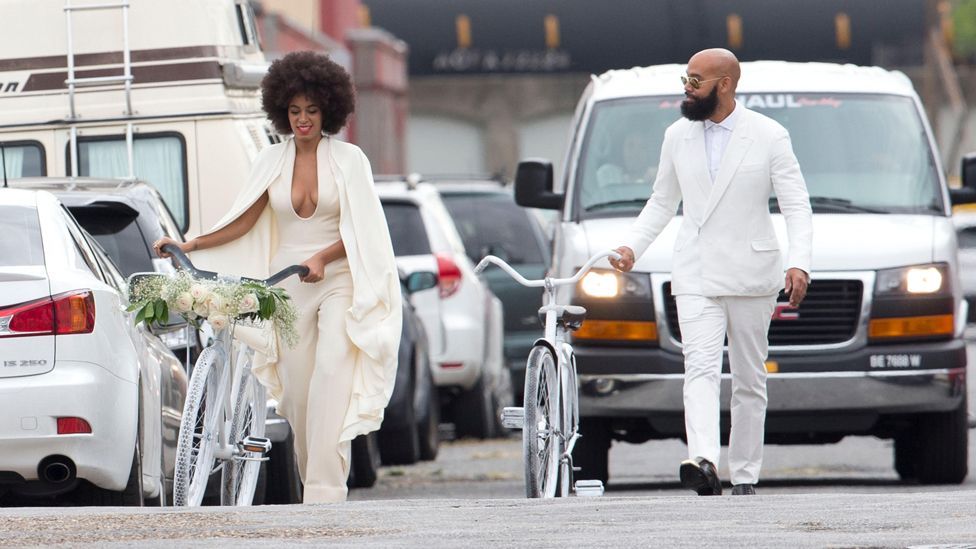
Solange Knowles wore a backless white one-piece when she married Alan Ferguson in 2014, and the couple arrived at their wedding on bicycles (Alamy)
Of form, the white (or ivory) wedding wearing apparel popularised past Queen Victoria has certainly endured, and there's no denying its totemic power. For many brides it encapsulates a hopeful, romantic nostalgia. "It can accept a transformative consequence," says senior curator at the Victoria and Albert Museum, Edwina Ehrman, who has studied how wedding dresses have changed in melody with fashion and order over the centuries. "And if you lot've already been living with your partner or even if y'all've had children you lot may want to article of clothing white at your wedding because you feel it marks a new phase in your relationship."
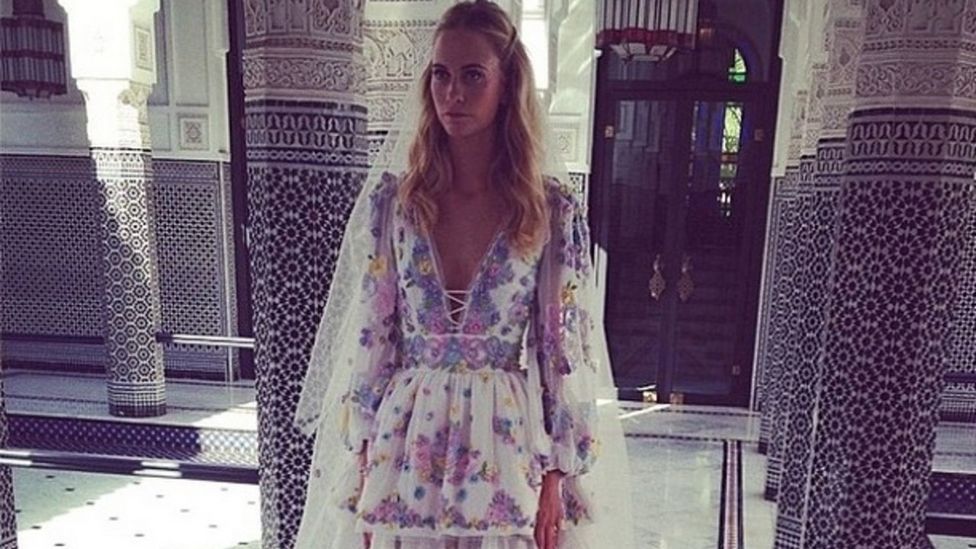
Poppy Delevingne got married in an unconventional floral, embroidered hymeneals gown
So quintessentially bridal has the white clothes become that now when a bride chooses to tie the knot wearing another colour, it's still considered daring and rebellious: recollect vocaliser Gwen Stefani in a dramatic dip-dyed number by John Galliano; or actresses Anne Hathaway, Jessica Biel and Reese Witherspoon all of whom wed in pink. And when designers Oscar de la Renta, Vera Wang and Temperley Bridal debuted non-white wedding-dress collections, it was initially viewed as a radical motion in the conservative conjugal-wear industry.
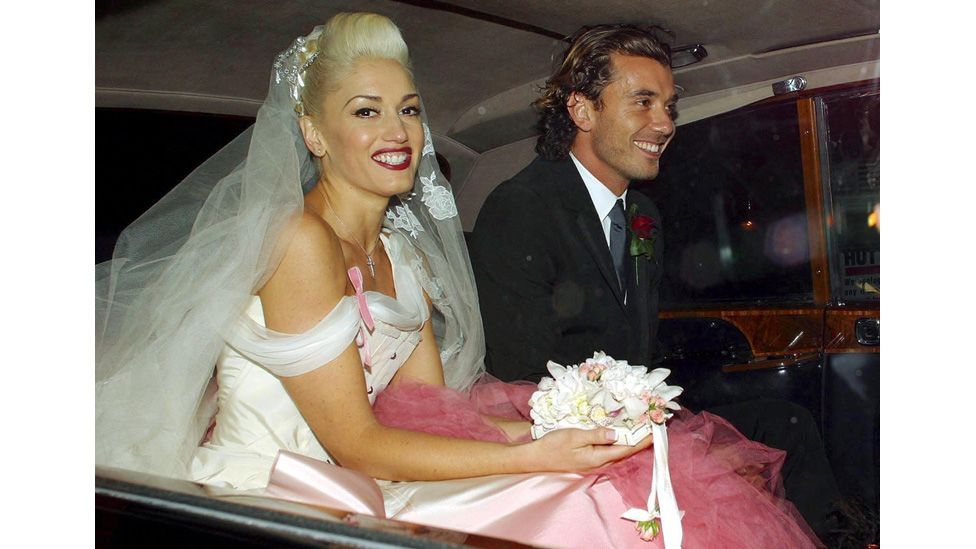
Gwen Stefani and Gavin Rossdale (Zandarin and Allen/Rex)
Yet getting married in pink, purple, xanthous, red (the typical bridal gown colour in Cathay) or any other color for that matter is cypher new in Western culture, nor peculiarly irreverent, says Ehrman. "Over the centuries, brides who were interested in fashion take frequently got married in different colours. And they would wear them many times afterwards, altering them over the years to fit in with fashion, or to fit a irresolute figure." And it was common for women not to buy a new dress for the occasion, but to merely get married in their best existing outfit.
Bridal fashion adapted to wartime as best it could. "People did what they could during Globe State of war II," explains Ehrman. "They would borrow a dress or wear their service uniform. Women in the armed forces could also rent a clothes, and some brides made dresses out of mantle textile. We accept an example in the evidence of a buttercup-print dress made of lightweight upholstery fabric."
Post-war, the mid-calf ballerina-length design became popular, favoured by women who had careers. In that location were some spectacular one-off gowns, too. Margaret Whigam, one of the first It girls, wore a big, showy gown by Norman Hartnell. "She was beautiful, rich and she loved the photographic camera – she was the perfect customer for Hartnell," says Ehrman. "That was not a garment that could be contradistinct for another occasion."
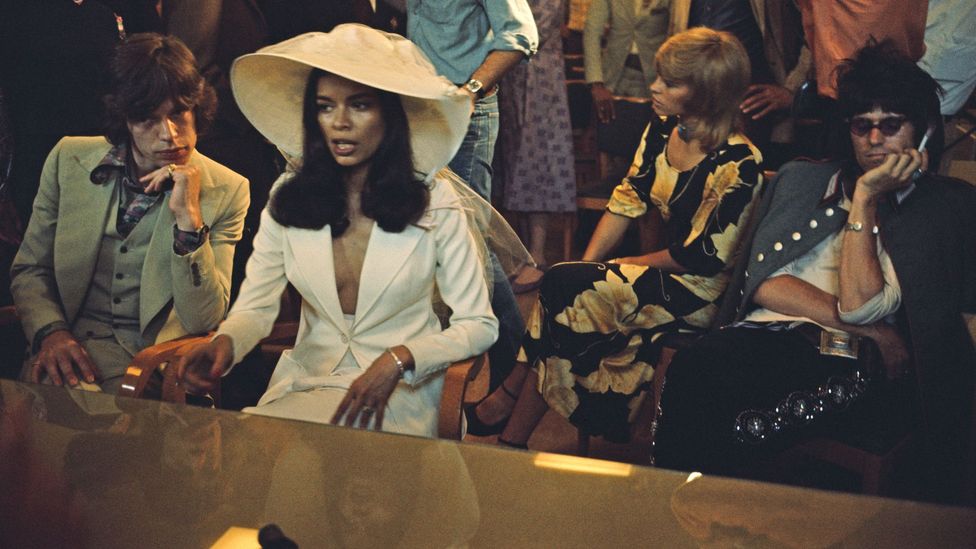
Bianca Jagger's white suit marked a new departure in conjugal wearable in the 1970s (Credit: Rolls Press/Popperfoto/Getty Images)
In the swinging '60s, singer Lulu sported a white hooded, fur-trimmed maxi coat over a mini clothes and high boots. The Thea Porter-designed empire-line dress displayed in a previous V&A nuptials-dress exhibition – "demure but flirty" as Ehrman puts it – in devore velvet, is quintessentially 1970s. "The reason the white wedding dress has survived is because information technology tin evolve and remain fashionable –it persists because information technology can be reinvented."
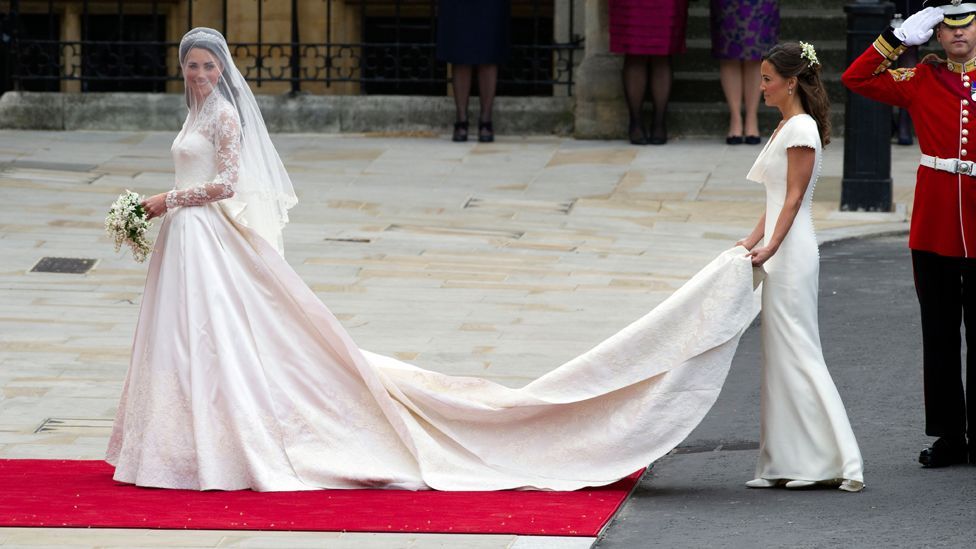
The Duchess of Cambridge wore a lace nuptials dress past designer Sarah Burton for McQueen (Credit: Alamy)
Designer Jenny Packham agrees. "The most memorable hymeneals outfits for me are those that define an era from a style perspective," she says. "Bianca Jagger in that white suit, Audrey Hepburn in a mini wearing apparel and head scarf." Packham designs bridal wear also as eveningwear (and is a favourite with many high-profile women, including the Duchess of Cambridge).
And then what era influences Packham'southward bridal vesture the about? "The 1930s are always a corking source of inspiration – a wonderfully corrupt and glamorous era between the wars, it was a design explosion of divine proportions."
And how does she predict the wedding dress will evolve? "The conjugal dress must stand out as a piece of clothing… At the moment there is a comfy stand up-off between the cherry carpet and the aisle. Neither wants to look like the other."
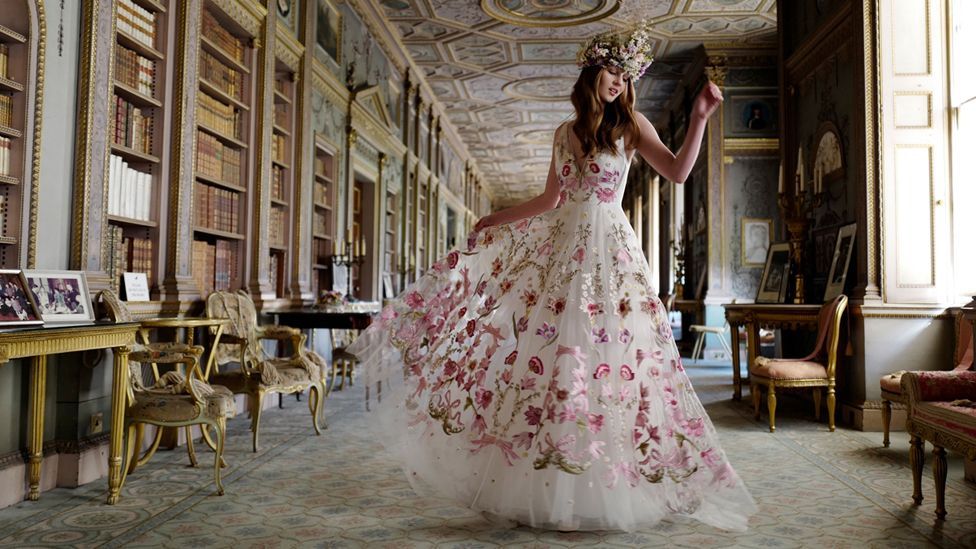
Wedding dresses with pink embellishment, such equally this i by Temperley Bridal, are increasingly pop (Temperley Bridal)
Alice Temperley is influenced by the silhouettes and spirit of the 1920s. Why has the romantic, ultra-feminine gown endured for and so long in her view? "The wedding dress is traditional, timeless and defies trends," she says, recalling her own wedding clothes, fabricated with "antique lace and 1920s sequins that I had nerveless since babyhood".
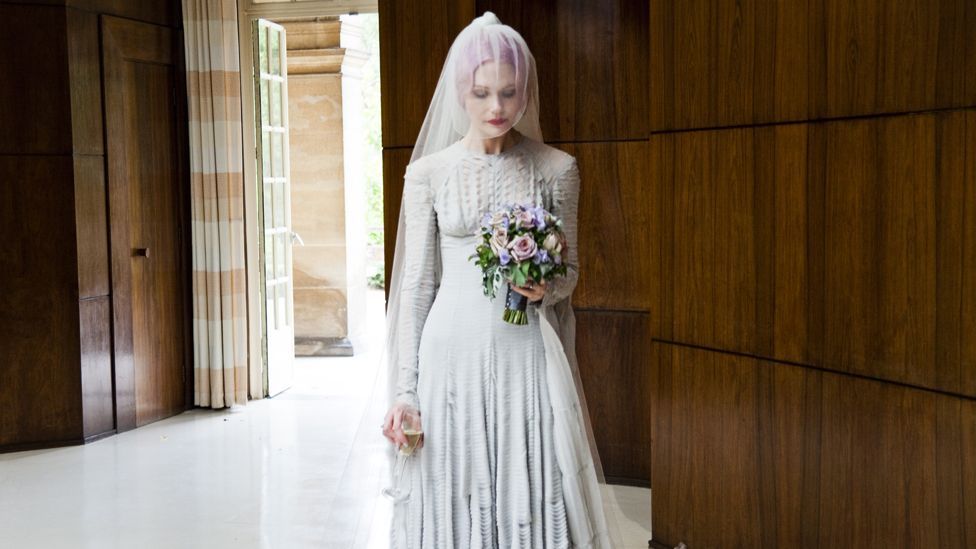
British designer Gareth Pugh'south wedding ceremony dress for stylist Katie Shillingford (Credit: V&A Museum)
It's all in the detail, agrees Gareth Pugh, who has created stage outfits for the likes of Lady Gaga and Kylie Minogue – and whose dramatic-just-romantic conjugal dress for stylist Katie Shillingford is part of the V&A collection. "A costume for the phase and a wedding dress both have very specific roles to fulfil," Pugh tells BBC Civilization. "Nonetheless, the arroyo and procedure are very different. Unremarkably with stage costume, condolement and the power to move effectually easily are height of the list, along with being visually striking.
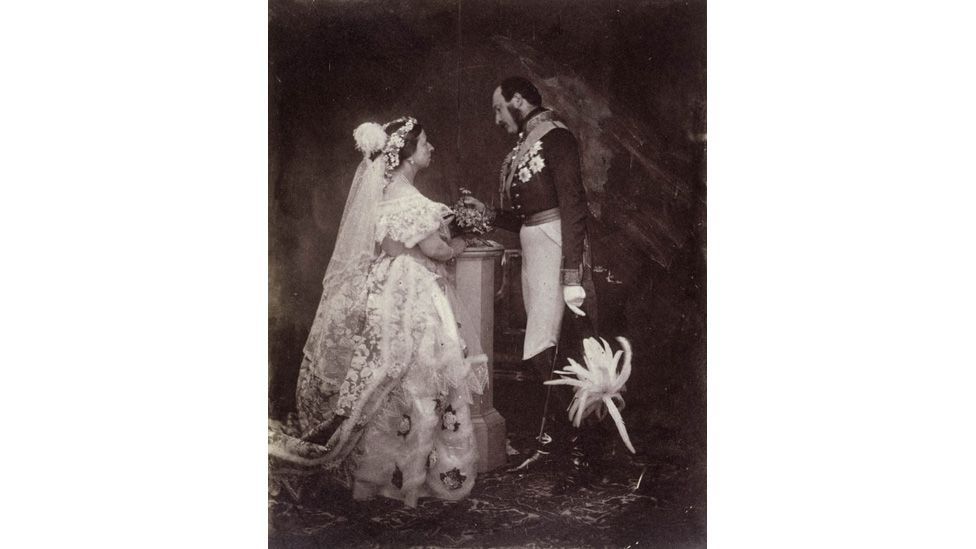
Queen Victoria and Prince Albert's nuptials in 1840 (Wikimedia Foundation)
"With a wedding wearing apparel there are layers of subtlety that you lot can achieve that yous just can't replicate on stage – commonly because a wedding wearing apparel is viewed in much closer quarters. And a bride is more than willing to forego condolement." And how does Pugh think the nuptials clothes volition evolve in the future? "I remember the idea of dressing up and presenting a side of oneself that is a fantasy will always appeal," he says. "For most, a wedding ceremony is possibly the one twenty-four hours where they are allowed free rein to really go to town. There will always be a niche market for the traditional white meringue, but I like the idea of the dress beingness a little more personal – something that is made with dear and care, something that takes fourth dimension and patience - a lot like the wedlock itself."
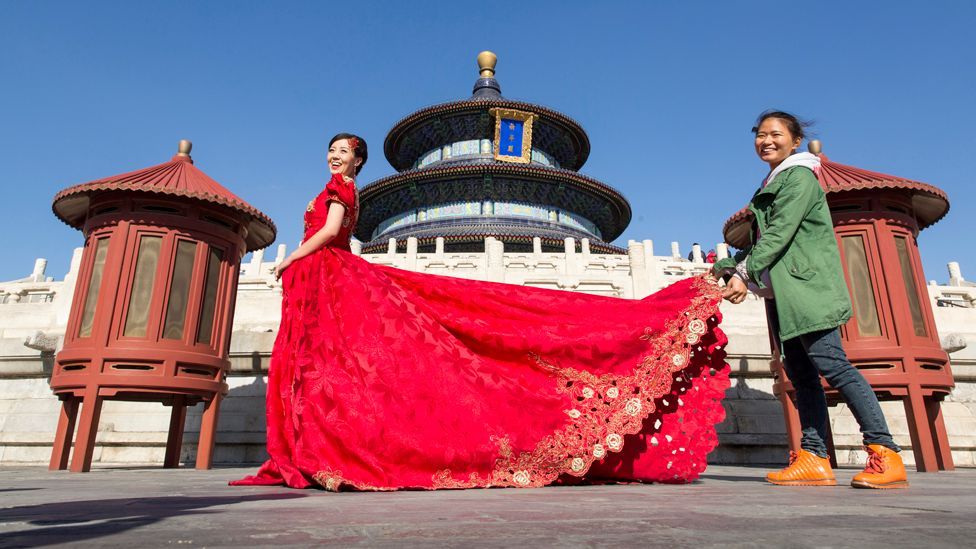
Brides in China traditionally wear reddish. (Corbis)
And new customs and apparel codes are being introduced constantly. Every bit Edwina Ehrman puts it, "Gay weddings and cross-cultural weddings are both examples of how new traditions are being established." All of which feeds into the multi-billion-dollar global wedding-attire industry. "At that place is definitely a spirit of competitiveness effectually weddings now – the bridezilla or groomzilla phenomenon is real," says Ehrman. And the alternative-hymeneals bridezilla who wishes to make a conscious statement through her wedding can be just as competitive – in fact, some are ditching the white nuptials apparel to make a indicate about gender politics.
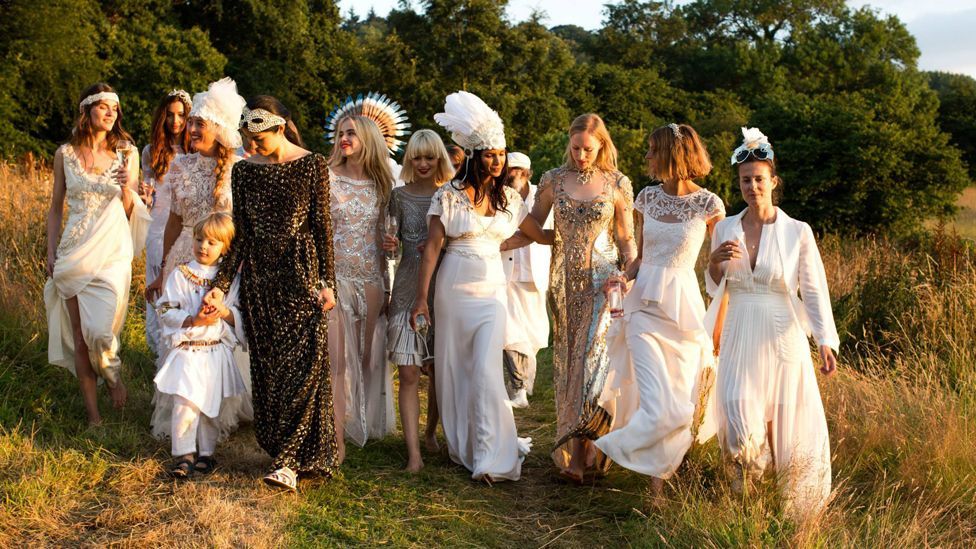
Alice Temperley'south boho-chichi bridal designs are inspired by a 1920s silhouette (Credit: Temperley)
That's nonsensical, says Ehrman. "If you want to wear a coloured apparel on your nuptials day, or trousers, or become barefoot, become alee. But the thought that wearing a white wedding dress is going to somehow enslave you is absurd – equality and respect are what matter in a union, not what you wear at your wedding. When it comes to modern bridal habiliment we are just incredibly lucky to have such a diversity of selection."
A version of this commodity was first published on BBC Culture in 2014. If you would similar to annotate on this story or anything else yous have seen on BBC Culture, head over to our Facebook folio or message us on Twitter .
0 Response to "Bridal Fashions From the Year 1980"
Post a Comment